Fit Life · Growth Library
Try Short High-Intensity Intervals Safely
Boost Fitness with HIIT
Try this
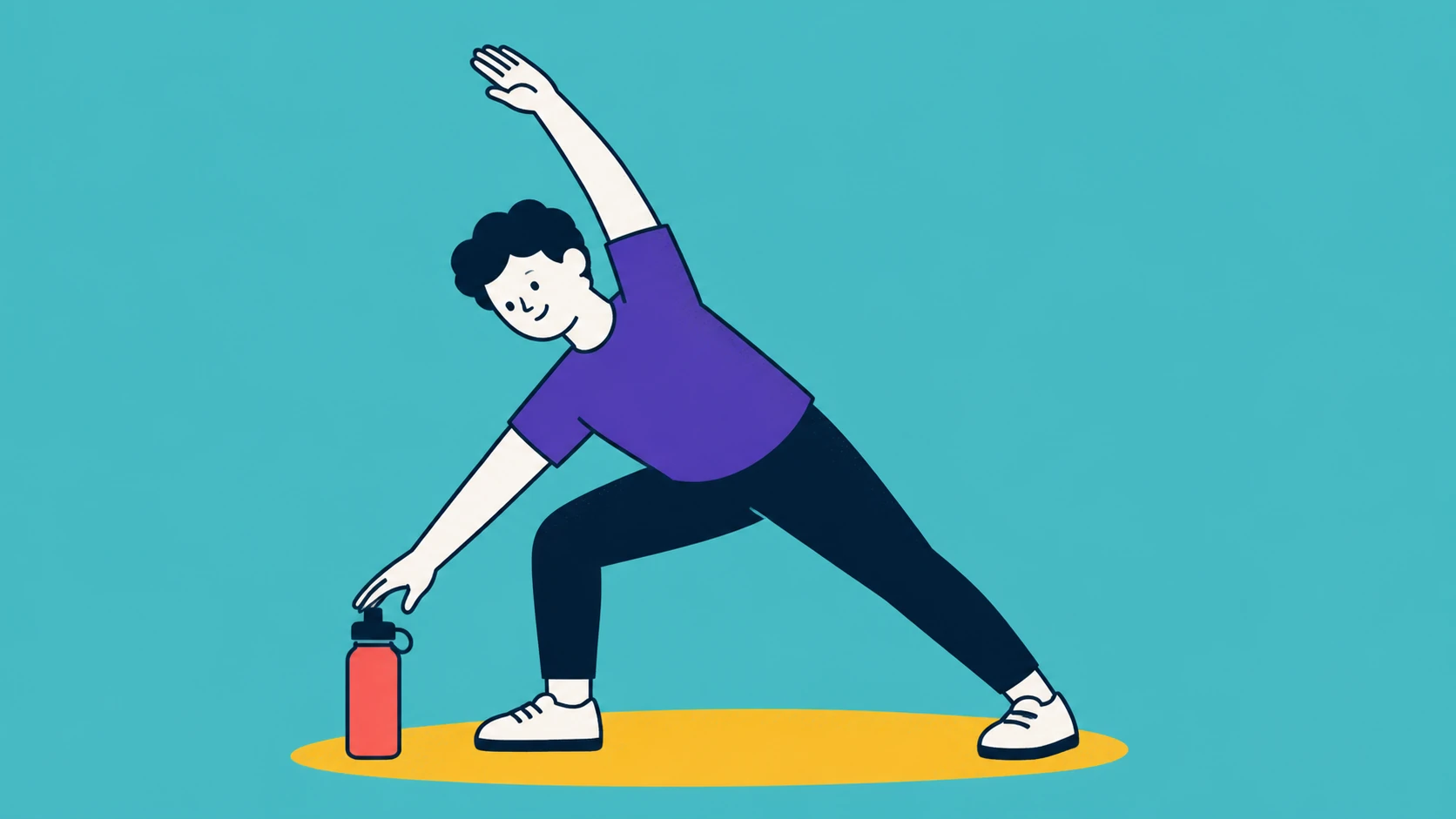
If vigorous exercise is appropriate for your current fitness and health, choose a simple movement you can perform safely. You can use it as one short interval session, or as brief exercise snacks separated across the day when a full workout is unlikely. Make the effort challenging but controlled. Treat 20/10, 3 × 1 minute, 4 × 1 minute and similar timers as formats to adapt, not scientifically optimized doses.
Check-in: Was the effort genuinely challenging but still controlled, could I repeat it without losing movement quality, and over several weeks is fitness or function trending in a useful direction rather than just my streak count?
Evidence: Reviewed · source · Meng L, Li Y, Chen J, Zheng H. Journal of Nutrition, Health & Aging. 2026;30(10):100940.
Review note: Public content is replaced by a sourced high-intensity interval protocol grounded in NHS physical-activity guidance, WHO guidance and the original Tabata study. Unsupported heart-rate targets, calorie estimates, injury-risk claims and arbitrary progression rules are removed, and the 20/10 format is presented as one specific interval format rather than a universal prescription.
Safety: This record is general educational material, not medical advice, diagnosis, treatment, or a substitute for professional care.
Short hard bouts are more interesting than the old internet story of ‘four magic minutes.’ A 2026 systematic review and meta-analysis of 21 randomized studies involving 921 adults found moderate-certainty improvements in cardiorespiratory fitness and peak power from exercise snacks: multiple brief bouts distributed through the day. But the same review found much shakier evidence for body composition and blood lipids, and it explicitly warns that cross-study subgroup patterns do not establish an optimal number of bouts, days per week or intervention length. The timer is not the active ingredient.
Brali therefore gives you two related options: use short intervals as one compact session, or distribute brief, genuinely challenging bouts across the day when that fits real life better. Neither option earns metabolic superpowers just because it is short.
1. Check whether vigorous exercise fits you
If you have not exercised for some time, have a medical condition, symptoms, an injury or concerns about your health, get appropriate healthcare advice before starting very vigorous exercise. Short duration does not make hard exercise automatically appropriate.
2. Choose a movement you can control
The trials used several modes, including stair climbing, cycling, resistance exercise and sprint-style work. That variety is useful: the evidence is about accumulating a meaningful exercise stimulus, not worshipping one exercise. Pick something familiar enough that you can make it harder without making it sloppy.
3. Decide: one mini-session or bouts across the day
A compact interval session puts work and recovery together. Exercise snacks separate brief bouts across the day. If your barrier is finding one uninterrupted workout block, the distributed version is a reasonable fallback. Do not quietly turn the evidence into a rigid schedule: the 2026 review found promising subgroup patterns for bout frequency and intervention duration, but the authors explicitly say those cross-study comparisons are not proof of an optimal dose.
4. Make the effort real; keep the timer humble
Use an effort that feels clearly challenging while you still control the movement. Twenty seconds on and ten off, three one-minute bouts or four one-minute bouts are all possible formats, not commandments. A timer can organize work. It cannot manufacture a physiological stimulus if the work itself is too easy, and it cannot make unsafe effort sensible.
5. Expect the strongest evidence where it is strongest
The 2026 RCT-only meta-analysis found improvements in VO2max and peak power with moderate certainty, despite substantial between-study heterogeneity. That makes cardiorespiratory fitness the most defensible reason to use exercise snacks. Body-fat and lipid results were low-certainty or inconsistent, so Brali does not sell this as a weight-loss shortcut or cholesterol hack.
6. Real life can dilute the laboratory stimulus
In a 2026 randomized real-world trial, 69 insufficiently active adults with type 2 diabetes were assigned to four one-minute vigorous bouts or four one-minute low-intensity mobility/stretching bouts on at least five days per week for 12 weeks. Adherence was high. The vigorous group improved 30-second sit-to-stand performance more, but did not outperform the active comparator on most other secondary outcomes, including HbA1c and estimated VO2max. That is a useful brake on the idea that merely completing the scheduled snack guarantees a broad cardiometabolic payoff.
7. Observe function, repeatability and the trend
Record the movement, approximate effort, whether you stayed in control and whether anything made you stop or modify it. Over several weeks, look for a useful trend in fitness or function: stairs feel easier, the same work feels more manageable, or a repeatable field measure improves. Do not infer calories burned, blood markers or VO2max from a stopwatch.
8. Do not confuse exercise snacks with ordinary movement breaks
A light walk or standing break can still be useful for comfort and for interrupting sitting, but that is a different question from using short bouts as a fitness stimulus. Brali's movement-break review found no evidence for one universal cognitive break cadence. Exercise snacks add intensity or training stimulus; the clock alone remains unimpressed.
9. Stop when the session stops being appropriate
Stop if you feel pain or become unwell. Do not use a streak, target heart rate, calorie estimate or final-round challenge as a reason to continue through concerning symptoms or loss of movement control.
Questions to consider
Does HIIT need to be 20 seconds on and 10 seconds off for 8 rounds?
No. The 20/10 format comes from a specific laboratory cycling protocol. The 2026 exercise-snack meta-analysis also included very different modes, bout lengths, frequencies and intensities. Short vigorous work can be useful, but the evidence does not establish one universal timer as the best prescription.
What is the difference between a short HIIT session and exercise snacks?
A short HIIT session groups hard and recovery intervals into one session. Exercise snacks are multiple brief bouts distributed across the day. The 2026 meta-analysis supports exercise snacks as a way to improve cardiorespiratory fitness on average, but does not show that a specific number of daily bouts or a particular timer is optimal.
Do exercise snacks improve weight, cholesterol or blood sugar?
Do not assume that. In the 2026 RCT-only meta-analysis, evidence was more consistent for cardiorespiratory fitness and peak power than for body fat or blood lipids. A 2026 real-world trial in adults with type 2 diabetes found the vigorous snack protocol feasible and improved sit-to-stand performance versus an active comparator, but found no between-group advantage for most other secondary outcomes, including HbA1c and estimated VO2max.
Should I aim for a percentage of my maximum heart rate?
Not from this Brali protocol. Approximate heart-rate formulas are not required to run this general experiment. Choose an effort that is challenging but controlled and appropriate to your fitness. If you have been inactive for some time, have a medical condition, symptoms or concerns, get appropriate healthcare guidance before vigorous exercise.
When should I stop?
Stop if you feel pain or become unwell. Do not let a timer, streak, calorie estimate or final-round challenge overrule concerning symptoms or loss of movement control. If you are unsure whether vigorous exercise is suitable for you, get advice from a healthcare professional before using it.
Sources
Evidence state: reviewed. Sources are provided so the underlying material can be inspected directly.
- Meng L, Li Y, Chen J, Zheng H. Journal of Nutrition, Health & Aging. 2026;30(10):100940.
- https://pubmed.ncbi.nlm.nih.gov/42502209/
- https://www.nhs.uk/live-well/exercise/physical-activity-guidelines-for-adults-aged-19-to-64/
- https://pubmed.ncbi.nlm.nih.gov/8897392/
- https://www.who.int/publications/i/item/9789240015128
Maintenance record
Review history
Current status: Reviewed. An editorial or evidence review is recorded and no later event changes that conclusion.
2026-09-09 · reviewed · Brali Evidence Reviewer Source: protocol-content-overrides-hiit-tabata.json
Update the reviewed short-HIIT page with 2026 exercise-snack evidence. The strongest fresh synthesis is an RCT-only systematic review/meta-analysis of 21 studies (921 adults) showing moderate-certainty improvements in VO2max and peak power, while body-composition and blood-lipid findings remain low-certainty or inconclusive. A 2026 real-world randomized trial in 69 insufficiently active adults with type 2 diabetes provides an important boundary: four 1-minute vigorous bouts on at least five days per week were feasible, but did not outperform an active mobility/stretching comparator on most secondary cardiometabolic or fitness outcomes. The page therefore distinguishes a short interval session from exercise snacks spread through the day, keeps safety boundaries, and rejects one magic timer or cadence as an optimized prescription.
Browse the review ledger · Challenge or update this hack
Implementation observations can trigger a review, but they cannot change an evidence conclusion by themselves. Commercial relationships do not control review status or outcomes.
Reviewed evidence decisions
These source reviews are linked to this hack for provenance. They do not change lifecycle status automatically; any material status change still requires an explicit lifecycle event.
2026-09-09 · support-existing ·
exercise-snacks-cardiorespiratory-fitness-boundary-2026Reviewed source. Across the included randomized studies, exercise snacks improved VO2max and peak power output on average with moderate-certainty evidence. This supports offering distributed brief exercise bouts as a practical cardiorespiratory-fitness option when a longer continuous workout is difficult to fit. The evidence does not establish one modality, timer, number of bouts, weekly frequency or intervention duration as the optimal prescription.
2026-09-09 · support-existing ·
exercise-snacks-real-world-t2d-boundary-2026Reviewed source. In this specific real-world type 2 diabetes sample, the four-by-one-minute vigorous exercise-snack program was feasible and improved 30-second sit-to-stand performance more than an active mobility/stretching comparator. The trial does not show a broad cardiometabolic or aerobic-fitness advantage for this exact prescription.
Continue from here
Choose the next useful path.
Article versions
Brali keeps substantive article history visible. Later reviews may refresh wording, sources, examples, or boundaries without silently replacing the record.
- Version 2025-10-06: first recorded publication in the migrated Brali corpus.
- Evidence review 2026-08-18: reviewed by Brali editorial agent; evidence state is
reviewed.
Canonical source record · Evidence state: reviewed.